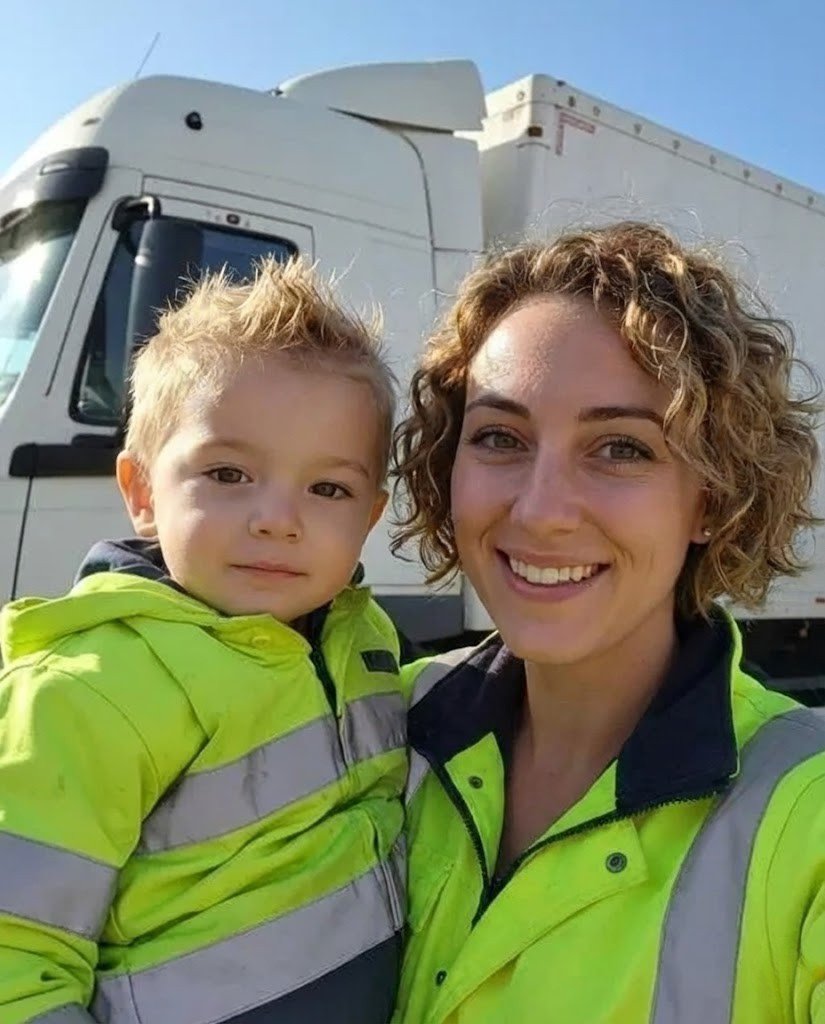
Driving freight with a toddler isn’t conventional, but for one mother, it was the only way to balance work and the high cost of childcare. The routine of matching hi-vis jackets and off-key songs was shattered outside Amarillo when her two-year-old son, Micah, casually asked when the “man who sits up front” was coming back. Terrified—as she never allowed passengers in her rig—she searched the cab only to find a meticulously drawn sketch tucked inside her glove box. The drawing captured a private, tender moment between mother and son that no stranger could have seen, accompanied by a note of encouragement that left her chilled and confused.
The mystery deepened as more sketches appeared in impossible places, like the locked cab’s visor and the interior of a milk carton. A diner waitress named Dottie later confirmed seeing a tall man in a worn denim jacket standing by the passenger side of the truck, only for him to vanish into the darkness the moment he was approached. Dottie discovered another sketch left behind, portraying the mother’s private tears while Micah slept on her chest. These weren’t just random drawings; they were hyper-specific snapshots of her life on the road, delivered by a presence that seemed to move through the shadows of the highway.
The emotional turning point occurred when the mother finally recognized the handwriting and artistic style as belonging to her older brother, Jordan, who had died in a car wreck six years prior. Jordan had been her lifelong protector but had never lived to meet his nephew. This realization transformed her fear into a profound, supernatural sense of comfort. Micah began relaying specific warnings from “Uncle Jo”—advising her to slow down just before hitting black ice or missing a turn—effectively acting as a bridge between the mother and her deceased guardian.
Now, with a collection of nine sketches, the mother no longer feels the crushing weight of the loneliness that often defines the long-haul lifestyle. The final message she received—reminding her that Micah would remember her strength and love rather than the miles—gave her the clarity to continue her difficult career with confidence. This experience serves as a beautiful reminder that love doesn’t always leave; sometimes, it simply changes seats to watch over us from the periphery. It suggests that for every traveler feeling isolated on a long road, we may never be as alone as we truly think.